
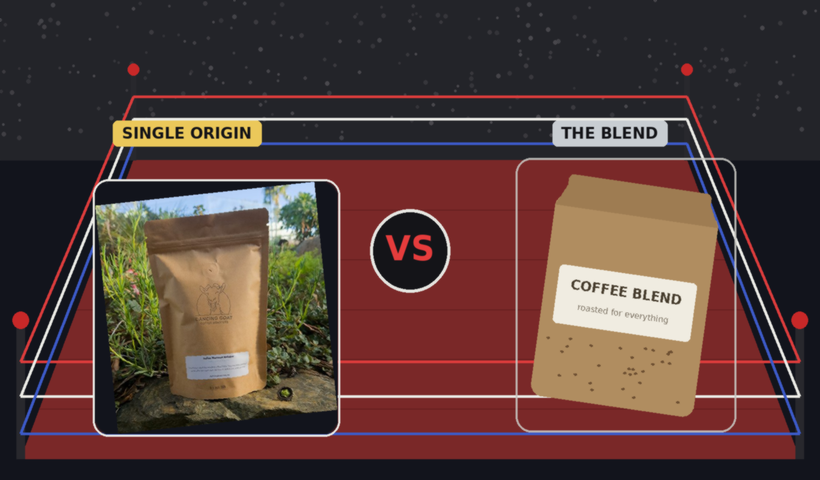
This one comes up a lot. And honestly, the answer is a bit more interesting than the usual "it depends" cop-out. So let's actually get into it.
The short version: blends were built for consistency, and for a long time that made them the obvious choice for milk-based coffee. Single origins are more exciting, but in milk they've historically been a bit of a gamble. The good news is that roasting approach changes everything, and that's where things get genuinely interesting.
Why blends became the default for cafe milk drinks
For most of coffee's modern history, espresso blends were the backbone of every cafe. The reason was practical. A blend gives the roaster control. You can take a bright, acidic Ethiopian and combine it with a heavy, earthy Sumatran, and you end up with something balanced that performs consistently across different espresso machines, different water temperatures, and different barista skill levels.
For a busy cafe pulling hundreds of shots a day, that reliability is incredibly valuable. Blends are also designed to work with milk, often literally. Roasters creating blends for wholesale cafe use are thinking about flat whites and lattes from the start. The whole point is a consistent, well-rounded shot that holds up when milk is involved.
So if you've been buying blends for your home machine and they've been working well, that's not a coincidence. Blends were engineered to do exactly that.
Where single origins get complicated
Single origin coffees, by their nature, are expressive. A natural-processed Ethiopian can taste like blueberries and rose water. A Kenyan washed coffee might have that intense blackcurrant brightness that makes your eyebrows go up. These are exciting, distinctive flavours, and they're part of what makes the specialty coffee world so interesting to explore.
But those same qualities can be tricky in milk. High-acid, light-roasted single origins often get muted, muddled, or even unpleasantly sharp once you add steamed milk to the equation. The subtlety you're paying for disappears. Or the acidity that was lively and complex in a filter cup becomes a bit abrasive in a latte.
This is why plenty of specialty cafes have a dedicated espresso blend on the menu alongside their single origin filter offerings. They're serving different drinks for different purposes.
So yes, if you walk into a specialty roaster and grab the lightest, most award-winning single origin they have, roasted for black coffee, and then make a flat white with it... you might be disappointed. That's a real thing that happens.
The roast level question
Here's the part most people overlook. The problem with single origins in milk isn't always the origin itself. It's the roast level and the intent behind the roast.
A Colombian coffee roasted light for filter will taste very different from the same Colombian coffee roasted to a medium level with milk coffee in mind. The flavour profile shifts. Acidity softens. Body builds. Notes that were sharp and citrusy in a light roast become caramel and stone fruit in a medium roast. It's almost like a different coffee.
This is actually the crux of the whole debate. When someone says single origins don't work in milk, they're usually talking about single origins roasted for black coffee. That's a specific context, not an inherent truth about the coffee itself.
Roasting for milk specifically changes the equation
At Dancing Goat, we only sell single origins, and we roast all of them with milk-based coffee in mind. That's the whole point of what we do. It's not a compromise. It's a deliberate choice.
What that means in practice is that we're selecting origins that have the right characteristics for milk, and we're roasting to a level that brings out body, sweetness, and low-to-medium acidity rather than chasing the bright, high notes that work better black. Our Indonesia Sulawesi Toraja isn't roasted the way you'd roast it for a cupping. It's roasted the way it needs to be roasted to make a really good flat white at home.
So does that mean we think blends are bad? Er... it depends. A well-made blend from a good roaster can be a genuinely excellent thing. The consistency and reliability are real benefits, especially if you're still dialling in your home setup. But we'd push back gently on the idea that single origins are inherently worse for milk. That's a roasting philosophy problem, not a single origin problem.
And honestly, many blends are fattened with inferior (cheaper) beans. Chocolate flavours favoured in milk-based drinks are often achieved through VERY cheap Robusta beans. Not inherently a bad thing (Robusta has its place), but the beans are up to a quarter of the price of Arabica beans. And yet the prices are around the same as a single origin. Someone's making margin!
The honest tradeoff
If you want guaranteed consistency and you don't want to think too much about it: a quality blend is probably the safer starting point. They're designed to be forgiving.
If you want something a bit more interesting, with the character and story of a specific place, and you're buying from a roaster who actually thinks about milk coffee: a well-chosen single origin is at least as good, and often more enjoyable. You just need to know what you're buying.
The question isn't really "single origin or blend?" It's "who roasted this, and what were they thinking when they did?"
Have a browse through our current range and see what we're working with. And if you have questions about which bean suits your setup, drop us a line. We genuinely enjoy talking through this stuff.
Browse our beans at our browsable bean shop.
Also, I'm secretly delighted at how crappy Claude images are - especially today's boxing ring reimagining. It gives me hope.


